Executive Summary
Customizable ultrasound coaxial cable assembly solutions represent the cutting edge of signal transmission technology for industrial automation applications. These precision-engineered cables are designed to deliver exceptional signal integrity, durability, and flexibility in demanding industrial environments. As the global ultrasound coaxial cable market continues its robust growth trajectory—projected to reach $90.05 billion by 2032 with an 8.11% CAGR—industrial automation stands as a key growth driver, demanding specialized solutions that can withstand harsh conditions while maintaining precise signal transmission for critical applications.
Market Landscape and Industry Analysis
The industrial automation sector presents unique challenges for signal transmission systems. Unlike standard applications, industrial environments demand cables that can endure extreme temperatures, mechanical stress, chemical exposure, and electromagnetic interference while delivering consistent performance. The total addressable market for ultrasound coaxial cables in industrial applications is estimated at $150-250 million annually, with significant growth potential as automation technologies continue to advance.
Key market drivers include the increasing adoption of non-destructive testing (NDT) in aerospace, automotive, and manufacturing sectors, where ultrasound technology plays a critical role in quality control and structural integrity verification. The Asia-Pacific region, led by China and Japan, is experiencing the fastest growth, fueled by expanding manufacturing capabilities and infrastructure development.
Technical Specifications and Performance Standards
Core Technical Parameters
Customizable ultrasound coaxial cable assemblies for industrial automation must meet stringent performance criteria:
- Impedance Matching: Precision 50Ω or 75Ω impedance control to prevent signal reflection and ensure optimal power transfer
- Bandwidth Capabilities: Support for frequencies up to 18GHz, enabling high-resolution imaging and sensitive detection
- Signal Attenuation: Low loss characteristics, typically ≤0.5dB/m @10MHz, ensuring minimal signal degradation over long runs
- Shielding Efficiency: Multi-layer shielding configurations providing >90dB EMI protection, critical in electrically noisy industrial environments
Industry Standards and Certifications
Leading manufacturers like FRS maintain comprehensive quality management systems to ensure compliance with international standards:
- ISO 9001: Quality management system certification
- ISO 13485: Medical device quality management (relevant for industrial medical equipment)
- IATF 16949: Automotive quality management system
- ISO 14001: Environmental management system
- RoHS 3.0 & REACH SVHC: Compliance with hazardous substance restrictions
Application Scenarios and Use Cases
Industrial Non-Destructive Testing (NDT)
Ultrasound coaxial cables are indispensable in NDT applications across multiple industries:
- Aerospace Manufacturing: Structural integrity testing of aircraft components, requiring cables with high-temperature resistance and vibration tolerance
- Automotive Production: Quality control in assembly lines, where cables must withstand robotic arm movements and exposure to cleaning agents
- Oil and Gas Infrastructure: Pipeline inspection and monitoring, demanding cables with extreme temperature tolerance and chemical resistance
Automated Manufacturing Systems
In automated production environments, ultrasound coaxial cables enable:
- Robotic Assembly: Precision signal transmission for robotic vision systems and automated inspection stations
- Quality Assurance: Real-time monitoring and defect detection during manufacturing processes
- Process Control: Integration with IoT-enabled systems for predictive maintenance and process optimization
Energy and Infrastructure
Critical applications include:
- Wind Turbine Monitoring: Vibration and structural health monitoring in renewable energy installations
- Power Grid Infrastructure: Non-destructive testing of electrical components and transmission systems
- Smart City Projects: Integration with automated monitoring systems for urban infrastructure
Product Features and Competitive Advantages
Customization Capabilities
Leading manufacturers like FRS offer extensive customization options to meet specific industrial requirements:
- Conductor Materials: Pure copper or silver-clad copper options, balancing conductivity with cost-effectiveness
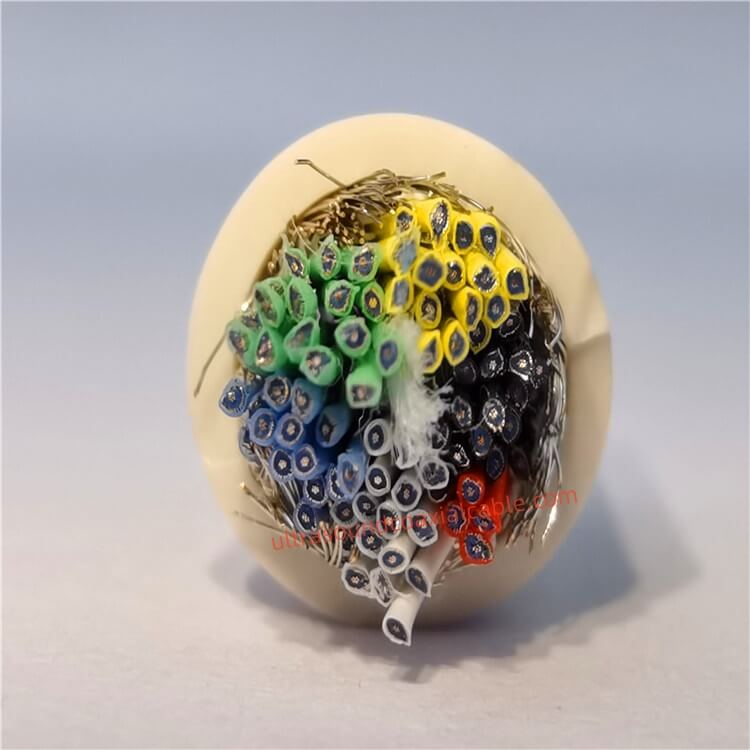
- Shielding Configurations: Single, dual, or triple-layer shielding designs tailored to specific EMI environments
- Connector Types: BNC, SMA, TNC, MCX, and custom connector configurations
- Outer Diameter: Options ranging from 0.2mm ultra-fine designs to 6.6mm OD for rugged applications
- Length Specifications: Custom lengths to optimize signal integrity and installation efficiency
Performance Enhancements
Advanced features that set premium ultrasound coaxial cables apart:
- Self-Healing Technology: Materials that autonomously repair minor damages, reducing downtime and extending cable lifespan
- High-Temperature Resistance: Operating temperature ranges from -40°C to +200°C, suitable for extreme industrial environments
- Mechanical Durability: Compression strength up to 100daN, withstanding industrial handling and installation stresses
- Flex Life: Endurance exceeding 10,000 flex cycles, ideal for applications with repetitive motion
Signal Integrity Optimization
Key performance metrics that ensure reliable operation:
- Insertion Loss: <0.3dB/m @5MHz, minimizing signal degradation
- VSWR: ≤1.15:1 up to 3GHz, ensuring efficient power transfer
- Phase Stability: ±0.5° over 10,000 flex cycles, maintaining signal consistency
- Impedance Control: 50Ω±1Ω @20MHz-6GHz, preventing signal reflection
Common Challenges and Engineering Solutions
Environmental Stressors
Industrial environments present multiple challenges that require specialized solutions:
Problem: Temperature Extremes
- Solution: Development of thermally stable cables with operating ranges from -65°C to +200°C, using advanced dielectric materials and insulation technologies
Problem: Chemical Exposure
- Solution: Chemical-resistant jacketing materials (medical-grade PVC, polyurethane) that withstand exposure to industrial cleaning agents, oils, and solvents
Problem: Mechanical Stress
- Solution: Enhanced mechanical protection through helical shielding wraps, strain relief boots, and reinforced connector interfaces
Signal Integrity Challenges
Problem: Electromagnetic Interference (EMI)
- Solution: Triple-layer shielding configurations combining braided copper, foil, and dielectric insulation, achieving 120dB EMI attenuation and 90%+ shielding efficiency
Problem: Signal Loss Over Distance
- Solution: Low-loss dielectric materials (foam polyethylene, PTFE) and optimized conductor designs to minimize attenuation, particularly critical for long cable runs in industrial facilities
Problem: Impedance Mismatch
- Solution: Precision manufacturing processes ensuring consistent 50Ω impedance control, with micro-coaxial constructions maintaining performance across bending radii <5mm
Reliability and Maintenance Issues
Problem: Cable Wear and Tear
- Solution: Self-healing technology that autonomously repairs micro-cracks and insulation breaches, extending cable lifespan and reducing maintenance frequency
Problem: Connector Failure
- Solution: Modular connector designs with compression termination tools, avoiding crimping that can degrade performance, and providing easy field replacement options
Problem: Water Ingress
- Solution: Weatherproof seals and moisture-resistant materials for outdoor and harsh environment applications
Manufacturing Excellence and Quality Assurance
Production Capabilities
Established manufacturers like FRS leverage over 20 years of manufacturing experience in ultra-fine ultrasound coaxial cable production. These facilities maintain:
- ISO-Certified Processes: Full-process digital management systems achieving product yield rates exceeding 99.8%
- Advanced Testing: 100% hipot testing (1500VAC/1min), thermal cycling, bend stress testing, and signal integrity verification
- Supply Chain Integration: Strategic partnerships with leading connector brands and material suppliers ensuring access to premium components
- Global Logistics: Reliable shipping networks supporting North America, Europe, and Asia-Pacific markets
Technical Support and Engineering Collaboration
Leading manufacturers provide comprehensive support throughout the product lifecycle:
- Design Consultation: Material selection guidance, impedance optimization, and custom connector configurations
- Prototyping Services: Rapid prototyping with lead times as short as 30 days for custom designs
- Application Engineering: Collaboration with customers to optimize cable performance for specific industrial systems
- Troubleshooting Support: Technical expertise for diagnosing and resolving installation or performance issues
Future Trends and Technological Evolution
High-Frequency Applications
The adoption of higher-frequency ultrasound technologies continues to drive demand for cables with superior performance characteristics. These applications require:
- Enhanced Bandwidth: Support for frequencies exceeding 200MHz, enabling higher resolution imaging and more sensitive detection
- Reduced Signal Loss: Advanced dielectric materials and conductor designs to minimize attenuation at elevated frequencies
- Miniaturization: Ultra-thin cables with smaller outer diameters while maintaining performance, driven by the growth of portable and integrated systems
Smart Cable Technologies
Emerging innovations include:
- Integrated Sensors: Cables with embedded microsensors for real-time performance monitoring and predictive maintenance
- Digital Signal Processing: Integration with IoT-enabled systems for enhanced diagnostic capabilities and remote monitoring
- Hybrid Designs: Coaxial-optical cables combining RF transmission with fiber optic control channels for multi-function applications
Industry 4.0 Integration
The convergence of ultrasound technology with Industry 4.0 initiatives creates new opportunities:
- Predictive Maintenance: Real-time monitoring of equipment health through continuous signal analysis
- Automated Quality Control: Integration with AI and machine learning systems for enhanced defect detection and process optimization
- Data Analytics: Leveraging signal data for process improvement and operational efficiency
Conclusion
Customizable ultrasound coaxial cable assembly solutions represent a critical enabler for industrial automation applications, providing the reliable signal transmission required for precision measurement, quality control, and process monitoring. As industrial environments become increasingly automated and data-driven, the demand for high-performance, durable, and customizable cable solutions will continue to grow. Manufacturers like FRS, with their extensive experience, comprehensive quality systems, and engineering expertise, are well-positioned to meet these evolving requirements and support the advancement of industrial automation technologies worldwide.